
Performance Under Pressure
Our IMTP improves your actual performance under pressure. For example, passing in soccer or shooting in basketball, you name it (Chan, 2025).
Athletic Development
We consider long-term athletic development. It is widely believed that mentally tough athletes are more likely to achieve success in sports (Hsieh et al., 2024)
A Brief Video
4 Systematic Steps in IMTP
Assessment
1 – 2 weeks
We consider individual differences by assessing athletes using approximately 8–10 questionnaires and conducting initial meetings.
Intervention
4 – 8 weeks, depends on the number of practitioners, and schedule of clients
We tailor the intervention for each athlete based on the assessment. Combing Psychological Skills Training and Pressure Training.
Evaluation
1 – 2 weeks
We compare pre- and post-intervention data from athletes and other relevant individuals, such as coaches and parents.
Retention
3 – 5 weeks, including data analysis
After a certain period, such as one year, we plan to provide a short and effective program on a regular basis to enhance the long-term retention of mental toughness.
Who is this program suitable for?
Athletes and Coaches in Universities, Colleges or Orgnaizations
Coopertate Workers in Business Setting
Disciplined Services or soldiers
Q & A
We provide almost all services ourselves, requiring minimal coordination from our clients. The IMTP primarily consists of a combination of group sessions and individual sessions.
For the group component, we encourage relevant stakeholders, such as athletes and coaches, to attend the sessions so they can better understand the program and its objectives.
For the individual component, our providers will coordinate directly with participants to arrange sessions and will provide progress updates and reports to the designated coordinators.
As mentioned above, the IMTP consists of four stages: Assessment, Intervention, Evaluation, and Retention. The first three stages are typically completed within 3–4 months. We offer flexible services, such as 6 months of service, accounting for coordination work, and a buffer.
Some clients may wish to undertake the IMTP again after one year. If most participants remain the same (assuming with some new participants), we recommend implementing only the Retention stage, since we already have a foundation in place; it is a more streamlined approach while still maintaining effectiveness. This allows participants to reinforce and sustain the skills and outcomes developed during the initial program.
Yes, we provide both summary reports and individual reports to our clients.
For example, if a client has 15 athletes participating in the intervention, we will prepare 15 individual reports, one for each athlete, as well as one overall summary report. These reports explain the relevant assessment data, intervention outcomes, and progress records related to the client and the participants.
The summary report provides an overview of the program’s findings and outcomes, while the individual reports offer detailed insights into each participant’s development and progress.
We offer a flexible service delivery model. For the IMTP, particularly the group-based components, we recommend conducting sessions in person to maximize engagement and effectiveness.
For individual sessions, services can be delivered either in person or online, depending on the needs and preferences of the participants.
To achieve the best outcomes, especially when clients request additional services related to the program, such as workshops, presentations, internship supervision, or wellbeing initiatives, we recommend providing 3–4 weeks of in-person support, with the remaining services delivered online. This hybrid approach balances effectiveness, flexibility, and cost-efficiency while maintaining a high standard of service.
We typically assign between one and three professionals to deliver the IMTP, depending on the scope and requirements of the project. The team may include:
- One Lead Sport Psychologist (Licensed)
- Up to one Sport Psychology Practitioner (Sport Psychology Degree Holders)
- Up to two Sport Science Researchers (Sport Science-PhD Students or PhD Holders)
- Up to three paid interns specializing in Translation, Research, or Counseling (Year 3/4 students or New Graduates)
For the paid internship positions, we prioritize recruitment opportunities for students from our client organizations (e.g., universities and colleges). We also provide supervision, training, and professional development support to ensure a valuable learning experience for the interns while maintaining the quality of service delivery.
Yes. However, the research plan should be finalized and ethical approval obtained before the program begins.
There are many potential research areas that could be explored. For example, studies could examine the dark side of mental toughness, differences in outcomes between elite and non-elite athletes, or the integration of psychophysiological measures to better understand performance and wellbeing.
We would be honored to support the research process, including study design, data collection, analysis, and dissemination of findings. We would also welcome the opportunity to collaborate on publications and research outputs upon completion of the program.
Basically, we offer Cantonese, Mandarin, and English. Since we provide paid internship opportunities in the field of translation, we are able to offer services in any of these languages. Moreover, with the use of AI tools, effective communication will become much more convenient.
Reference:
Chan Hing Wan, O. (2025). Practical Individualized Mental Toughness Program: A Case of Hong Kong Non-Elite Shuttlecock Youth Athletes. Journal of Sport Psychology in Action, 1–16. https://doi.org/10.1080/21520704.2025.2583998
Chan Hing Wan, O., Ely, G. (Manuscript). Practical Individualized Mental Toughness Program: Examine Retention Effect With A Mixed Analysis From A Case Of Hong Kong Non-Elite Shuttlecock Athletes
Gucciardi, D. F., Hanton, S., Gordon, S., Mallett, C. J., & Temby, P. (2015). The concept of mental toughness: Tests of dimensionality, nomological network, and traitness. Journal of Personality, 83(1), 26–44. https://doi.org/10.1111/jopy.12079
Hsieh, Y. C., Lu, F. J., Gill, D. L., Hsu, Y. W., Wong, T. L., & Kuan, G. (2024). Effects of mental toughness on athletic performance: A systematic review and meta-analysis. International Journal of Sport and Exercise Psychology, 22(6), 1317–1338. https://doi.org/10.1080/1612197X.2023.2204312
● About
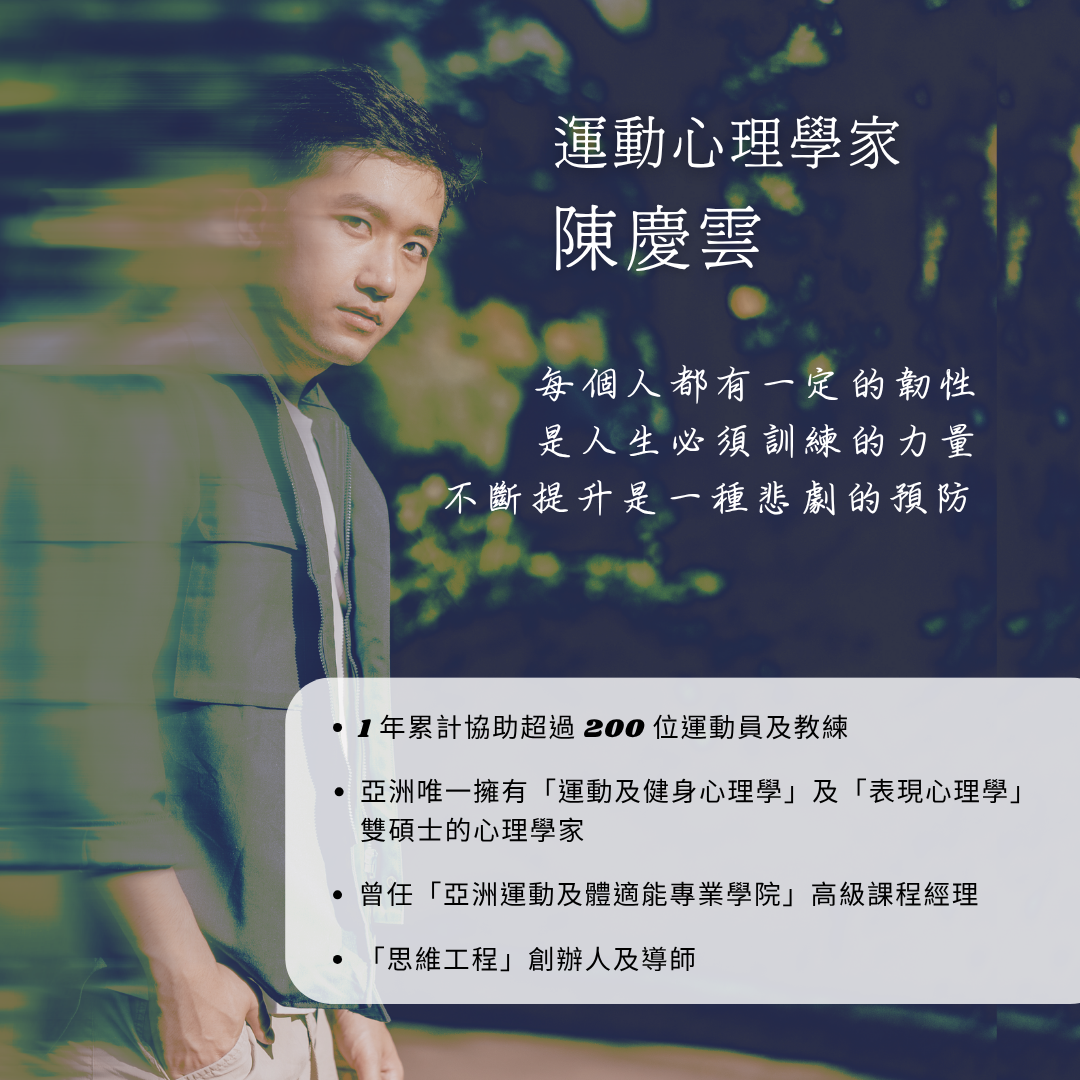
Sport Psychologist Lead
Want to get more details?